Kitchen Mischief Turns a Floating Citrus Still Life Into Patio Art
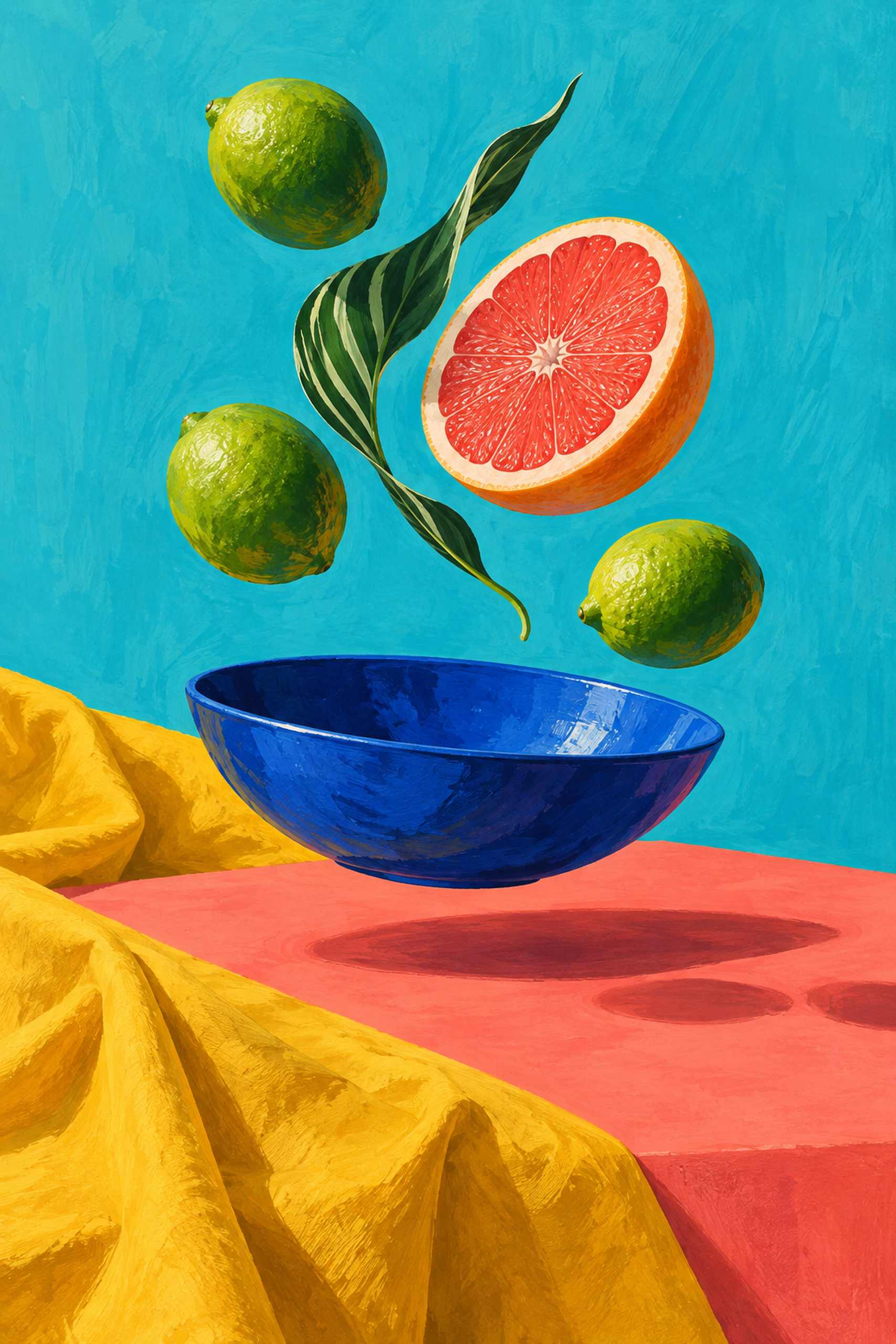
The fruit has escaped the bowl, and the bowl seems to have joined in. Kitchen Mischief 02 takes an ordinary citrus still life and removes one dependable feature: gravity. Limes and a cut grapefruit hover above a cobalt dish, with a coral surface and turquoise ground keeping the arrangement bright. The impossible part is confined to the artwork. On the patio, the chairs still need all their legs and a drink is best kept on an actual table. That little distance between painted mischief and practical furniture is the point of the composition.
The room illustration places the poster on the protected back wall of a covered patio. Terracotta tiles give the floor a warm, irregular texture, while a turquoise folding table and mustard-colored chairs establish two firm areas of color. A potted citrus tree stands near the open side, where the shaded space meets the brighter garden beyond. The print sits in a narrow wood frame rather than a brightly colored border. Inside it, the bowl, leaves and suspended fruit form a more animated arrangement than anything in the surrounding space. The natural wood edge gives that activity a simple stopping point.
The poster is a painted fantasy, with textured color fields and a deliberately unstable still-life arrangement. It does not claim a traditional regional pattern or attach an invented cultural explanation to a bowl of fruit. Turquoise, coral and yellow can be used because their relationship is lively enough on its own. The darker greens keep the limes and leaf from merging with the blue background, and the pale cut surface of the grapefruit introduces another kind of detail. At a distance, the main shapes read first; closer up, brush-like edges and surface variation become more apparent.
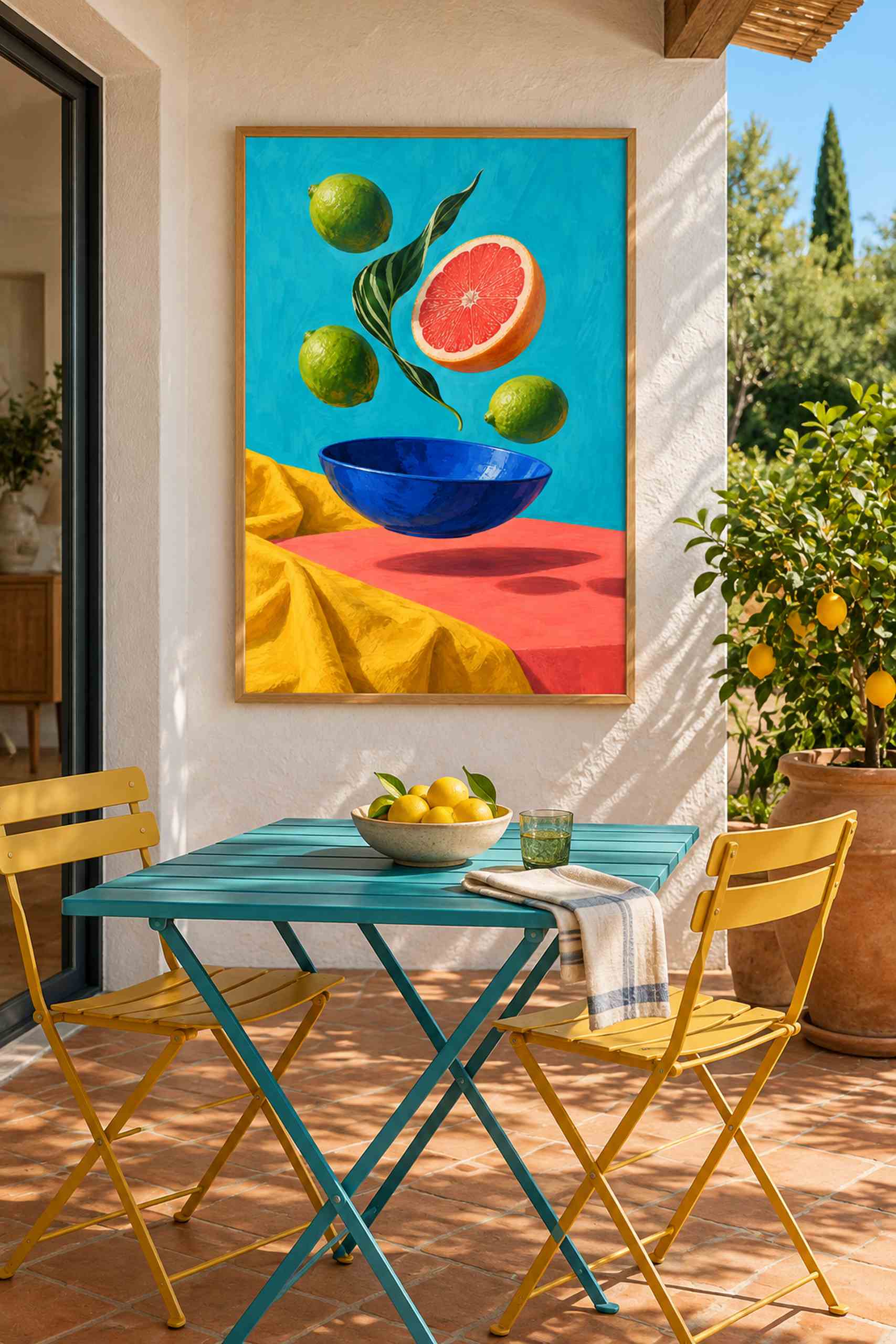
A picture with this much color can either establish a patio palette or interrupt an existing one. Our concept takes the first approach, repeating turquoise and mustard in the furniture while leaving the walls pale. An equally useful version could keep ordinary wood chairs and allow the poster to be the only strong statement. I would avoid adding citrus motifs to every other surface. The real tree already provides a particularly good counterpart, because its branches, changing leaves and uneven fruit are so different from the poster’s controlled arrangement. There is more pleasure in that conversation than in buying a matching set of fruit cushions.
The new work moves Kitchen Mischief beyond the single emblem of the first red pepper poster. That design uses a large red silhouette and a blue curve to make a direct graphic statement. This one has several objects, more depth and a small visual joke. The collection remains focused on food as an opportunity for color and personality, but its pictures should not all behave in the same way. A small kitchen might benefit from the pepper’s simplicity, while the more expansive covered patio gives the floating still life a different context.
Before choosing a frame, compare paper templates for a 40 by 60 centimeter image area and a 50 by 75 centimeter version, allowing separately for the border. A print positioned behind a dining table needs to be judged from the approach to the patio, from inside the house and from a seated position. These are proposed sizes, not measurements taken from the generated scene. Check whether an open door, a hanging plant or a person sitting at the table blocks the image in normal use. If the patio is small, moving the frame sideways may solve more than enlarging it. The artwork should participate in the gathering rather than requiring its own protected viewing lane.
A covered patio still presents conditions that an ordinary interior wall does not. Check exposure to humidity, direct light, wind-driven rain and any nearby cooking before deciding whether a physical paper print and frame belong there. The AI-generated scene illustrates a sheltered location; it does not test the durability of any material. Where the patio is exposed, an indoor wall visible through the doorway can preserve the connection between picture and outdoor table. The useful idea travels easily: a familiar bowl of fruit, a more adventurous arrangement of color, and one impossible detail to notice while the coffee is still entirely real.