Night Windows Turns a Rainy City Scene Into an Entrance Hall Focal Point
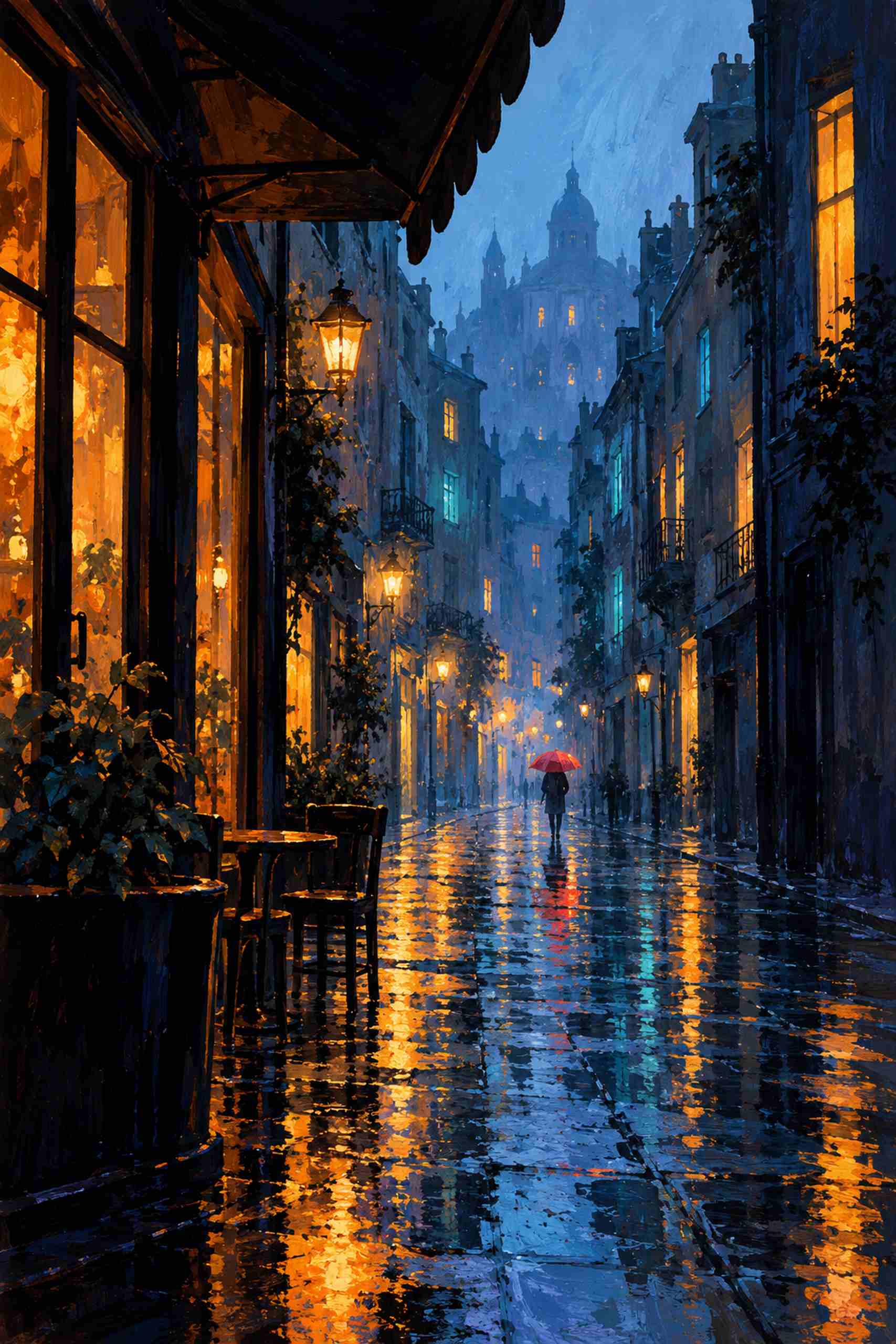
There is rain in the picture, which is a good place for it when you have just come home. Night Windows 01 looks down an invented street at blue hour, where amber and turquoise light run into wet dark pavement. A small figure with an umbrella gives the scene a human scale, but most of the painting belongs to buildings, reflections and the interval between them. The poster brings a little city atmosphere to an entrance hall without requiring the hall to resemble a hotel lobby.
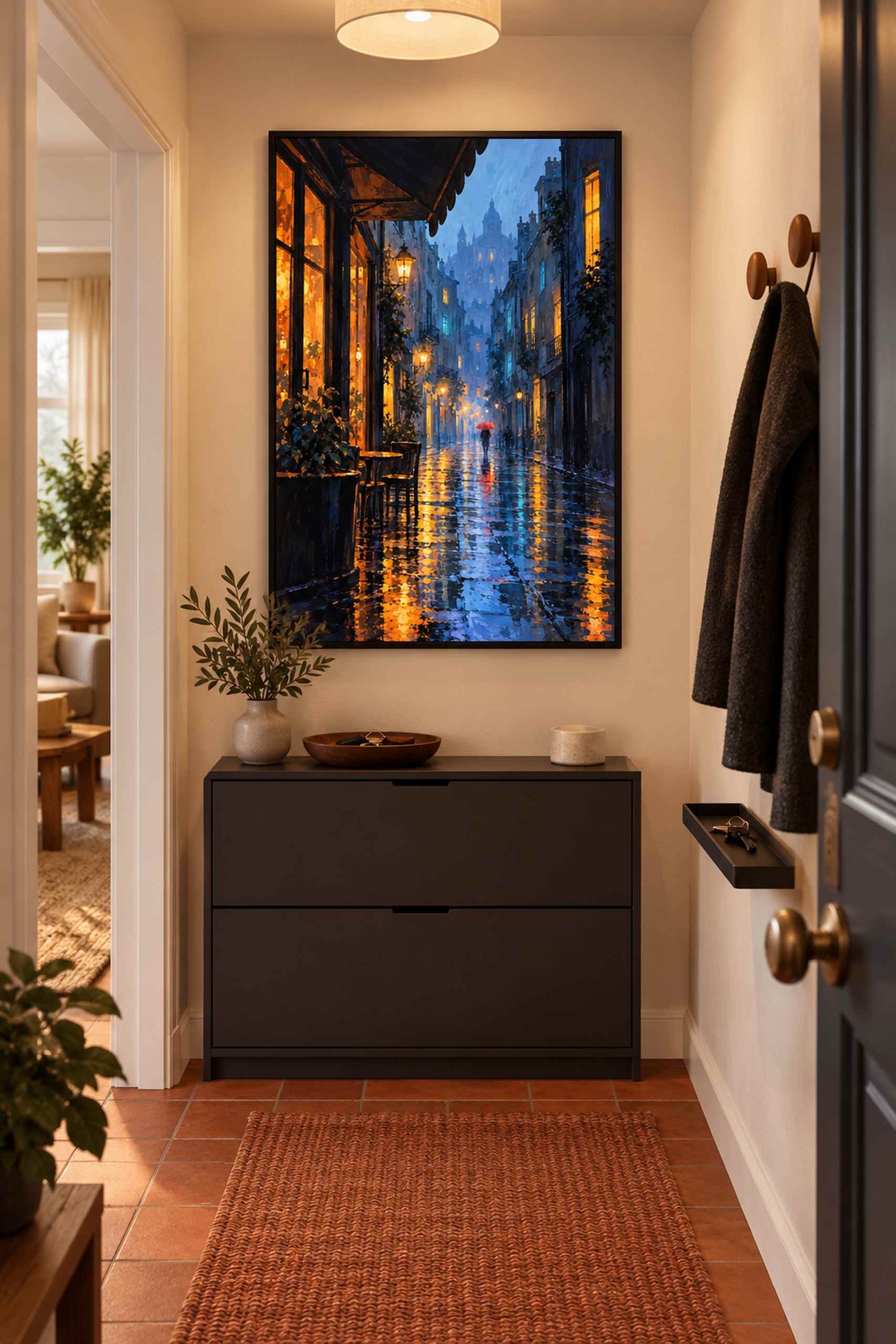
The interior concept is deliberately modest: a closed shoe cabinet, a shallow place for keys, a few hooks and a clear walking route. The framed street scene sits above the cabinet, visible from the entrance. Its dark border relates to the shelf and hardware, while the warmer light inside the picture has a loose counterpart in the room lighting. The contrast is useful. The hall stays dry, ordinary and easy to use, while the artwork holds the more complicated weather. A picture can make an entrance feel less like a passage without putting another piece of furniture in it.
Inside the composition, the street narrows toward the distance and the brighter marks become less definite as they recede. The umbrella supplies a small warm interruption among the blues. One lit window has a steadier vertical presence than the reflections beneath it. Those reflections are where much of the painted movement occurs: they stretch, break and merge rather than describing every paving joint. The city is intentionally unnamed. There is no claim that this is a photograph of Tokyo, Seoul, New York or any other real place, and no invented shop sign pretending to locate it. The subject is an urban evening, made through color and perspective.
Night Windows opens a collection around that kind of atmosphere. It differs from After Hours in the listening corner, which builds an evening mood from large abstract shapes. This work provides a scene with depth and a tiny implied story. The two can belong in the same home without becoming a matching set. I would let them occupy different kinds of space: the abstraction can accompany staying put, while the street view makes sense where people arrive and leave. That is a design interpretation, of course, rather than a rule about what a hallway picture must depict.
A hall gives a poster several audiences. It is seen close up while someone reaches for keys, across a short distance from the door, and perhaps at an angle from another room. Before choosing a size, test the proposed outside frame shape in each of those views. A 30 by 45 centimeter image area may be enough above a compact cabinet; a 40 by 60 version could work on a broader wall. These are planning examples and do not describe dimensions measured from the generated interior. Keep the door swing, switches and the things people carry through the entrance in the picture, figuratively speaking, before fixing the position.
The darker image also deserves a look under the actual hall light. An attractive patch of reflection on glazing can hide the painted reflections you wanted to see. Check from the usual approach rather than only from straight in front of the wall. A lamp position, glazing choice and viewing angle interact, so product descriptions alone cannot promise a particular result in every hall. The AI-generated scene is an arrangement to consider, not a demonstration of tested lighting or printed color. A physical sample under the existing light is more useful than assuming that the poster will look exactly as it does on a bright screen.
I would keep the surrounding accessories fairly quiet. The umbrella in the artwork does not need a matching umbrella stand, and the amber windows do not require a row of amber glass objects on the cabinet. Real keys, mail and a coat already supply changing detail. The print works best when it offers one sustained view beyond those small daily interruptions. Coming home is rarely as cinematic as a rainy painted street, and that is perfectly fine. The door closes, the shoes come off, and the weather can remain on the wall.