Paper Garden Makes an Orange Lily the Focus of a Small Gallery
One flower can occupy a gallery wall without pretending to be a small landscape. Paper Garden 03 takes an orange lily-like bloom and gives its curled shape most of the attention. A green stem carries the eye downward, a broad leaf supplies another plane, and a deep blue field makes the warmer petal feel luminous. The picture is deliberately assertive. It has no interest in becoming a faint botanical pattern that happens to be hanging above a bench.
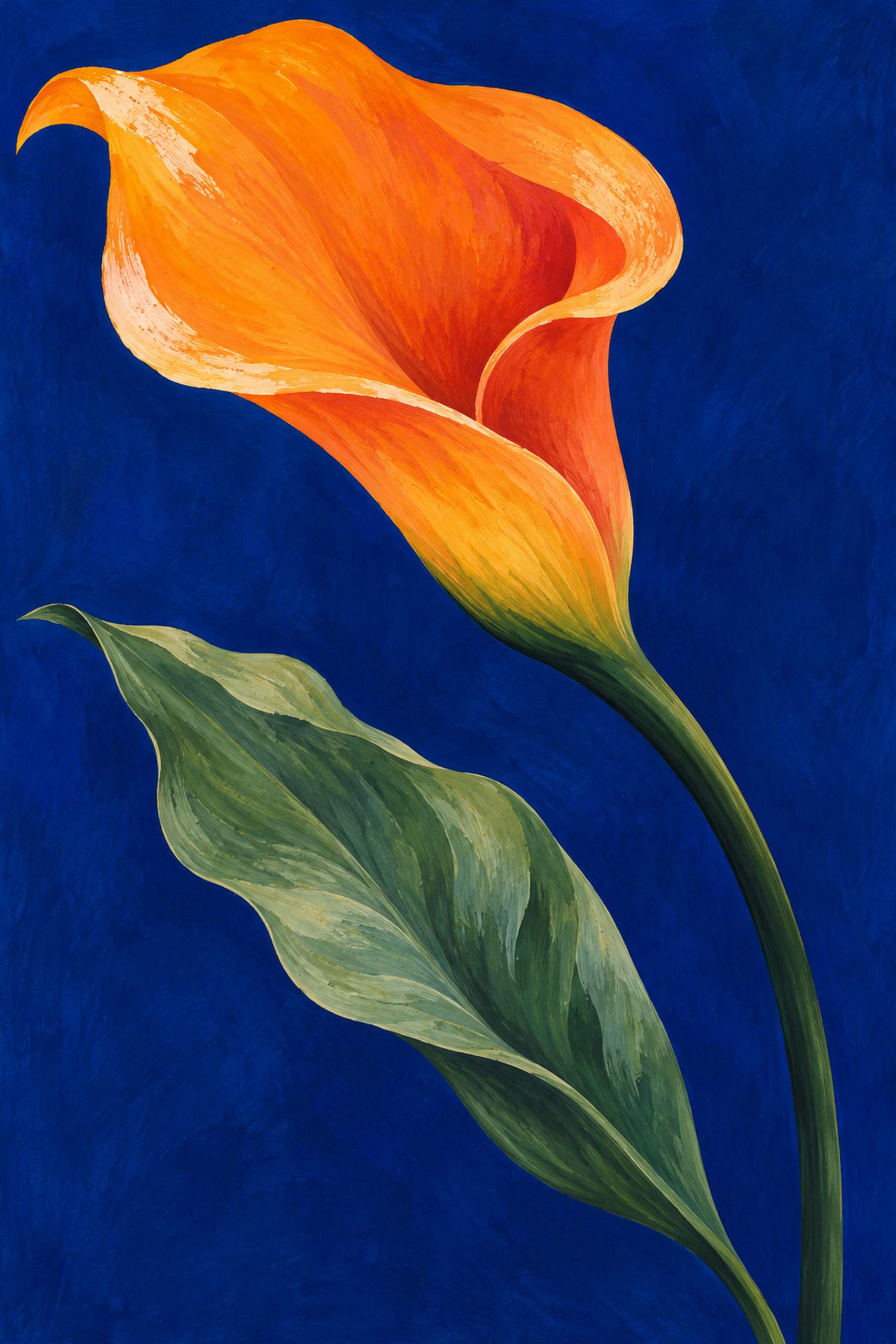
The new work changes the scale of Paper Garden’s botanical language. The first design arranged several flat leaf silhouettes around a narrow stem, while the flowering branch allowed smaller blossoms to spread across an open field. This poster asks one much larger form to carry the composition. The orange surface turns inward toward a warmer red fold, and the painted edges introduce small changes in texture. Green is important but secondary. The blue surrounding it is a large positive decision, rather than an empty area waiting to be filled with more flowers.
Our gallery concept gives that color relationship a simple architectural setting. Pale walls, a grey floor and a slender bench leave the framed image as the principal event. A small object on a separate plinth provides a different scale of interest without becoming a second wall display. The room is an AI-generated proposal for a compact exhibition space, not a record of a completed show or an artist’s installation. Its modest proportions matter. The poster should be convincing on an ordinary wall, not only in an enormous room where any picture can acquire an air of importance through distance.
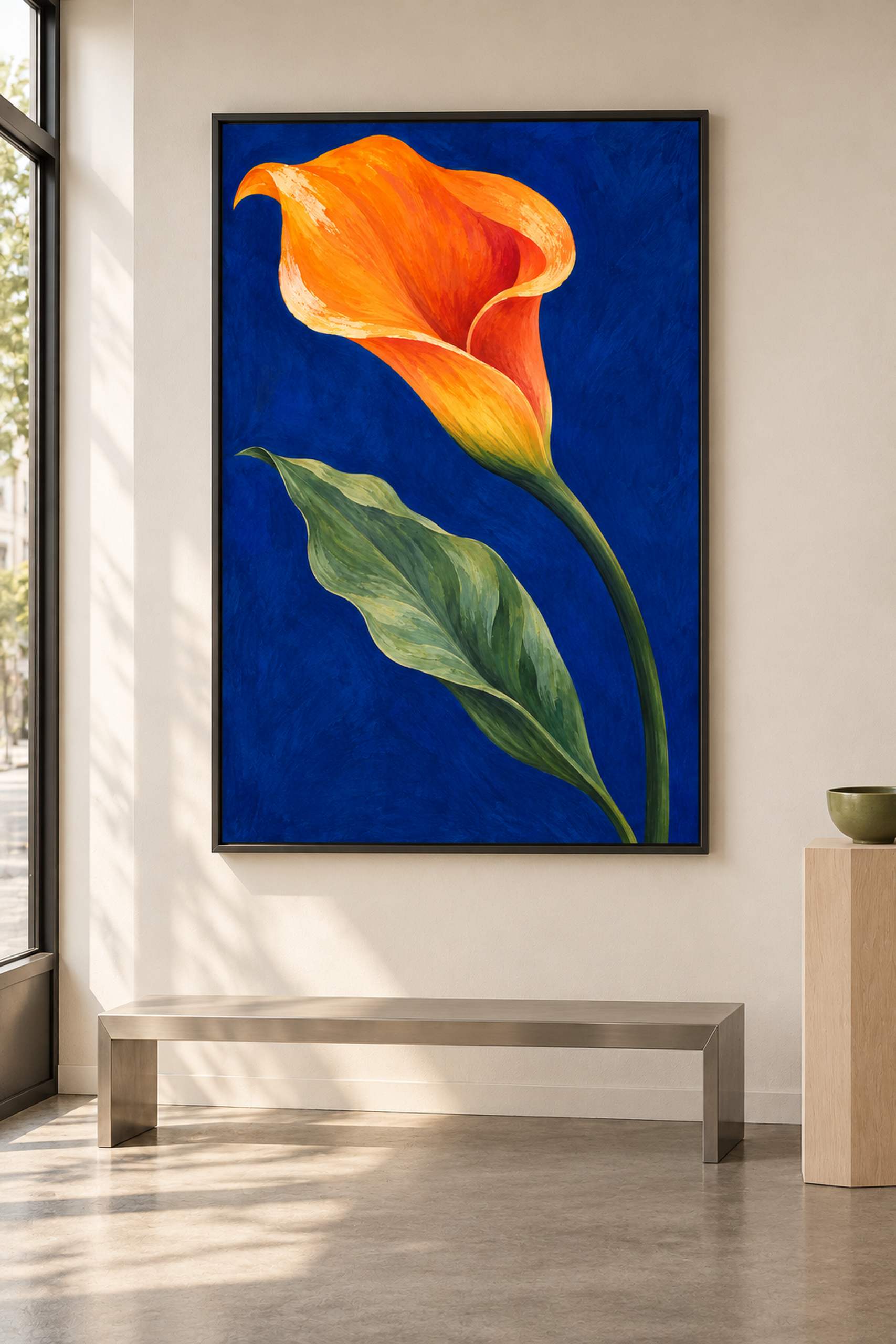
A narrow charcoal frame gives the deep blue field a firm perimeter. Light oak would bring a warmer edge, while white could make the boundary less emphatic against the wall. In this setting I prefer the darker option because the petal already supplies enough warmth and the small room does not need another material connection explained at length. The bench can remain a bench. Its horizontal line balances the poster’s long stem without copying it. The plain space around the frame lets the flower be large without making the whole wall feel occupied.
For a worked installation example, a 50 by 75 centimeter image area offers a fairly substantial portrait format. The actual frame increases those outside dimensions, and a mat increases them further, so test the full footprint rather than only the printed rectangle. These measurements are proposed examples, not dimensions inferred from the illustrated gallery. View the template from the entrance and from the spot where someone would naturally stop. A large bloom can be clear at a distance while its painted edges become interesting closer up. That range is part of the appeal, and it can be lost if the frame is squeezed into a narrow gap between unrelated objects.
The word lily describes the visual idea here, not a promise that the work is a botanical identification plate. This is an original AI-assisted interpretation with a deliberately enlarged curl and simplified supporting shapes. It also exists as a digital artwork rather than a photographed canvas. Those distinctions leave the image free to be judged on what it actually offers: a strong contour, an orange-blue relationship and enough variation in the painted-looking surface to avoid a mechanically flat result. A future physical print would still need its own paper, color and finish decisions. The web preview cannot settle those by itself.
I would avoid placing a large orange vase directly beneath the picture simply because it matches the flower. The poster has already made its argument. A smaller green ceramic object elsewhere in the room can introduce a looser relationship, or the furniture can stay entirely neutral. This is the sort of image that benefits from a few decisions left unmade around it. There may be several possible ways to furnish a gallery corner, but the flower only needs a clear wall and a frame that does not compete. The rest of the space can remain open enough for someone to stand still and look.