Wild Assembly Gives a Blue Home Office a Warm Fox Focal Point
The fox keeps its warm paper-like layers when the wall behind it turns blue. That is the useful experiment in this office: the artwork has not been recolored to match a room, and the room has not borrowed the whole woodland setting of the image. Wild Assembly 02 becomes one warm, figurative object within a more emphatic contemporary workspace. Its orange body and pale chest remain clear against the cooler surrounding wall, while the frame provides a modest material boundary between them.
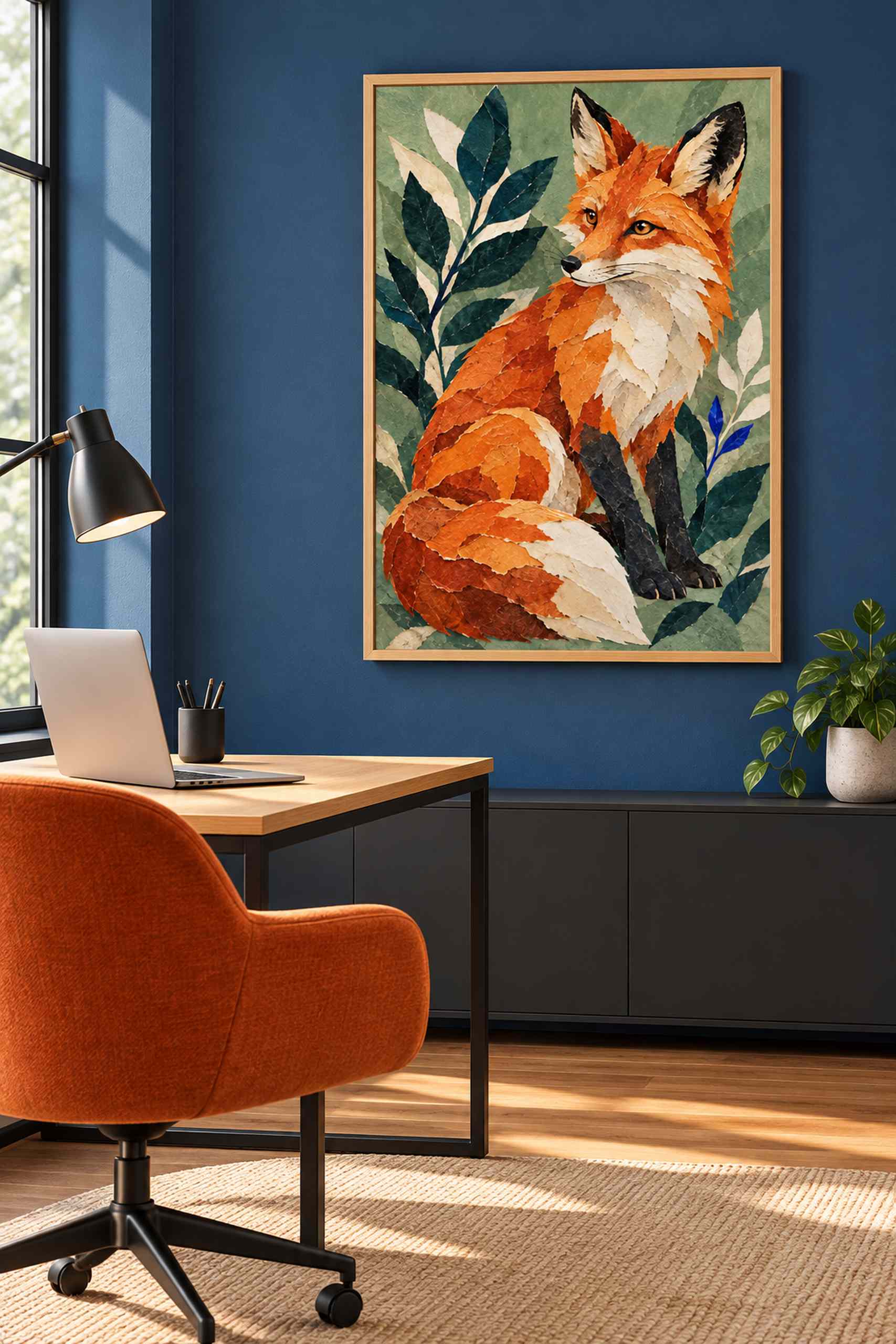
The office concept uses a cobalt-toned back wall, a dark metal desk structure, a light worktop and an orange chair. The picture sits above a closed storage unit beside the desk, where its full rectangle is visible rather than partly hidden by a screen. A small plant introduces a living shape without turning the room into a staged forest corner. The working surface remains available for a laptop, lamp and notebook. This is a bolder room palette than the fox’s home-library setting, and the change gives the same image a different kind of company.
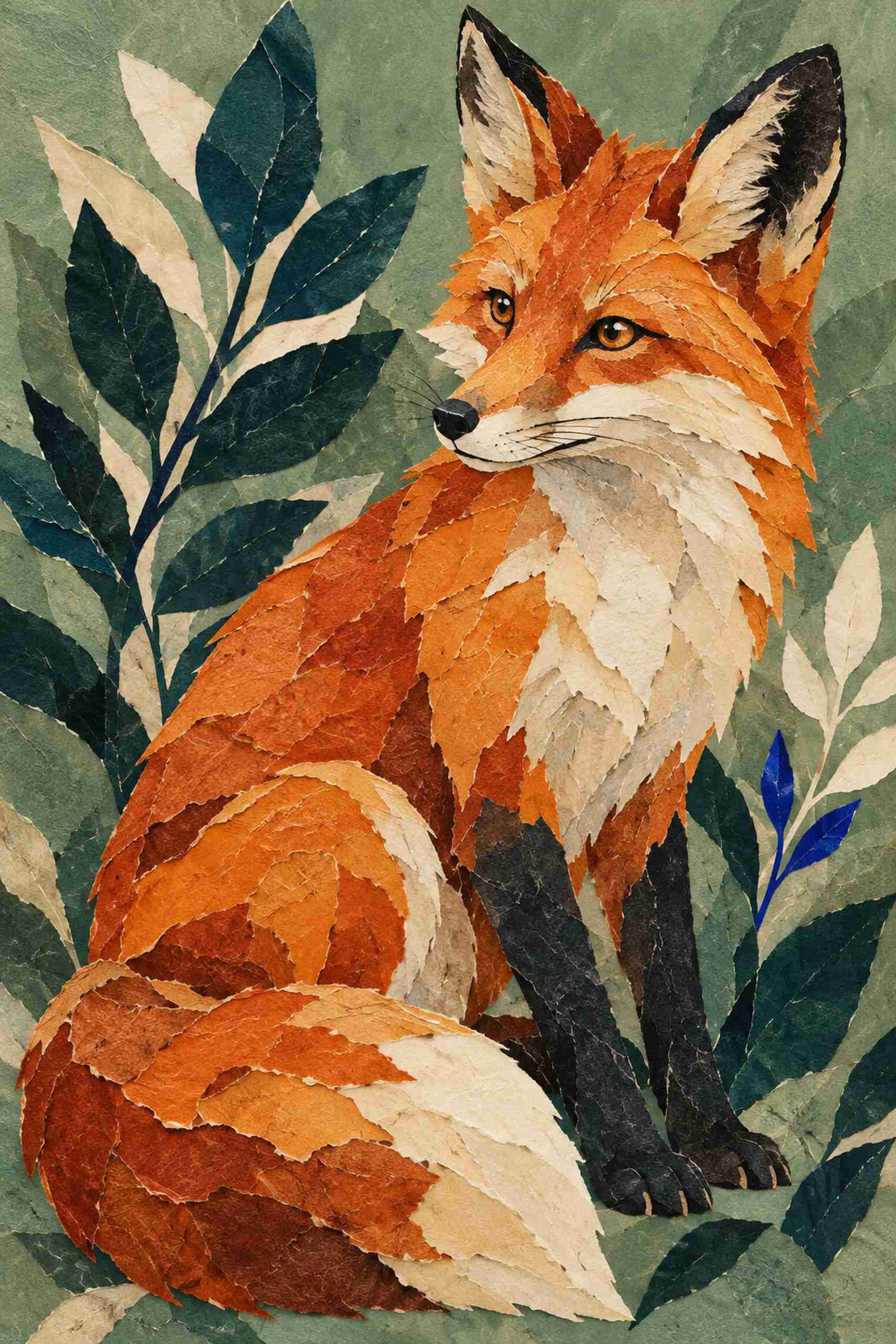
Inside the print, the orange and rust areas build the body through overlapping pieces, while the pale chest and dark legs keep the pose legible. Cooler leaf shapes and the sage ground remain part of the artwork itself. The fox is an original illustrative collage, not a scientific animal plate or a photographed physical construction. Those distinctions matter less to the room’s palette than the shape of the warm silhouette, but they keep the image’s identity clear. A new office scene is an application of the existing work, not a reason to generate a different fox under the same number.
The orange chair makes the color relationship fairly explicit. It is a useful way to see how a warmer functional object can carry some of the picture’s character into the room without adding a row of ornaments. The chair does not need to match the fox exactly. Differences in material, light and surface will prevent that kind of match from being stable anyway. The broad relationship is enough: a warm upholstered form below, a warmer animal shape within the frame, and a cool wall around both. A black chair could make a quieter version of the same arrangement if that is what the room already contains.
Light wood on the frame and desk top gives the blue a less severe edge than an entirely black-and-blue scheme might have. A slim black frame would make the print more self-contained, while a pale border could relate more directly to its chest and paper-like ground. I would test the frame against the painted wall before deciding on a mat. Extra pale border changes the object’s outside footprint and may become a larger shape than expected beside a compact desk. There is no reason to add it automatically simply because the image contains many small layered edges.
For placement, include the equipment in its normal working positions. An external monitor, a raised laptop stand or a lamp arm can hide a portion of the lower frame even when the wall looked clear while the desk was empty. A paper template of the actual outside dimensions is useful from the seated position and the entrance. The generated concept does not supply the measurements of your desk or storage. Keep cabinet access and the usual route to the chair comfortable. The picture is there to add character to the workspace, not to make using it more elaborate.
There is no claim that a fox on a blue wall improves concentration or makes work more creative. It provides an expressive image and a clear warm-cool relationship that may be enjoyable to live with. Printed color and apparent paper texture still require a physical sample under the room’s light; the web preview is not a print proof. I would keep the room’s everyday tools visible and allow the artwork to remain the most figurative part of the scheme. The fox can look alert without every desk accessory being recruited into the story. The notebook is allowed to be plain.