Moonlit Harbor in Blue and Gold
Most waterfront pictures ask us to look toward the city. Moonlit Harbor asks us to look up first. A round, pale moon hangs surprisingly high in an immense field of midnight blue, with only a delicate halo around its edge. The city and its boats seem almost incidental until the eye travels downward and discovers how much is happening along the waterline. This is what makes the landscape particularly interesting as a poster: it has the intimacy of a harbor scene and the spaciousness of an almost abstract composition. Neither quality has to be sacrificed for the other.
The balance is deliberately uneven. The moon sits toward the upper right, the tall sailing ship just left of center, and the passenger vessel enters from the right edge. Between them lies a stretch of open water and a distant cluster of illuminated buildings. There is no need to center the moon above the sailing ship or to make the skyline symmetrical. The eye can take a slow, diagonal route through the picture, from that small bright disc toward the illuminated rigging and then across the golden trail on the water.
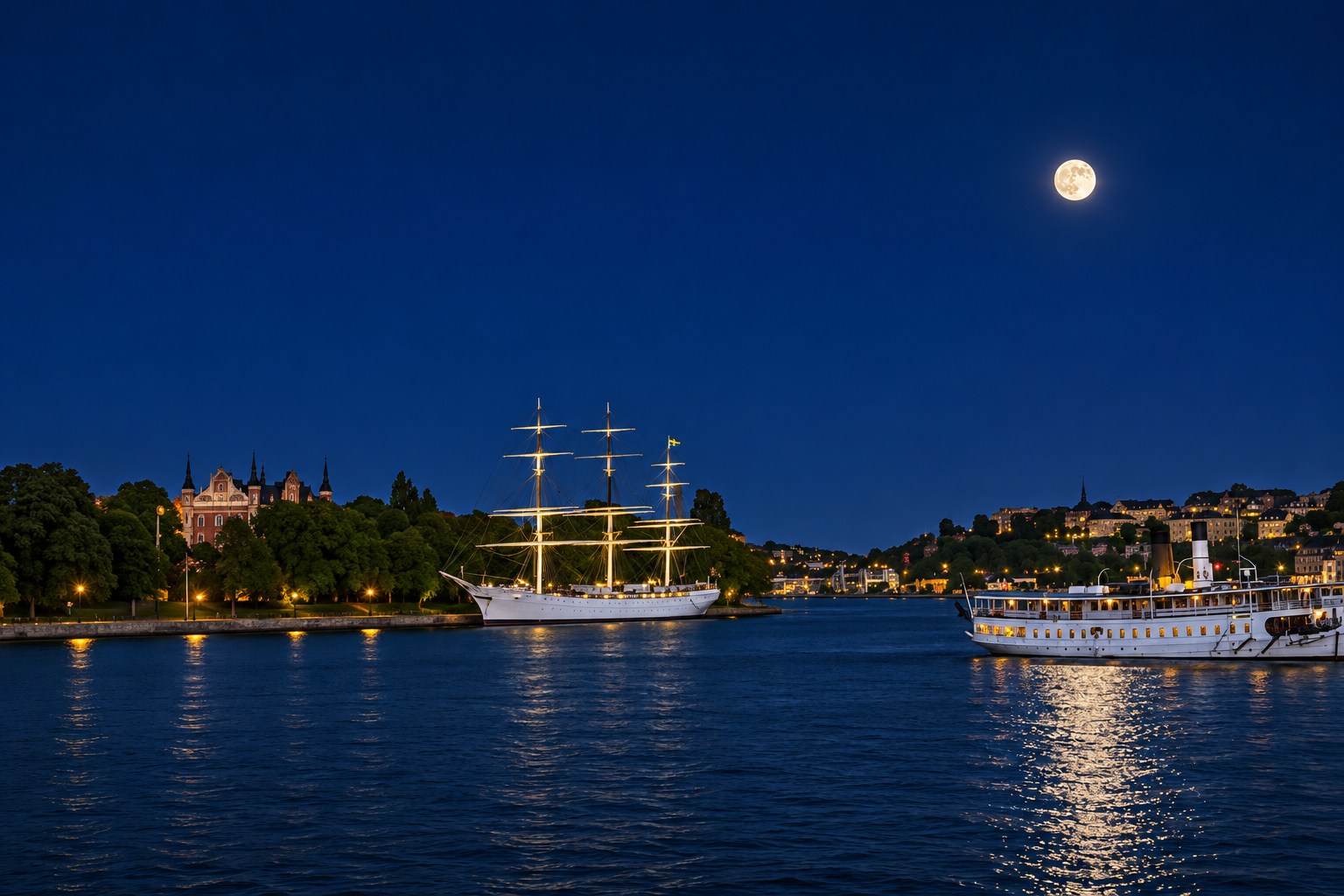
The sailing ship is the most intricate element of the design. Its three slender masts rise above a white hull, crossed by horizontal yards that catch a warm amber light. Fine rigging lines are visible against the blue sky. Those lines give the composition a delicate architectural quality, rather like the construction of an elaborate drawing on dark paper. On the right, the other vessel is heavier and more horizontal, its rows of rectangular windows shining warmly and its funnels silhouetted against the hillside. The contrast between these two types of maritime architecture brings a pleasant tension to what is otherwise a very quiet scene. One reaches upward, the other stretches across the water.
Behind the sailing ship, trees form an irregular, nearly black boundary, interrupted by the pointed roofs and warm brick facade of a historic-looking building. The far shore rises into a gentle slope dotted with little amber lights. None of this needs to be inspected individually for the poster to work. At a distance, the buildings and trees merge into a low, richly textured band that anchors the enormous sky. Come closer and there is another level of detail to enjoy. It is a useful quality in a wall image, which will be seen from across a room much more often than from arm’s length.
Blue and gold are the dominant colors, but they are not distributed equally. Navy and cobalt occupy most of the surface, while the warmer tones are confined to narrow strips, small windows, the rigging and the broken reflections. The water carries a particularly lively patch of pale gold beneath the right-hand boat, fading into smaller ripples toward the lower edge. It is tempting to think of the moon as the brightest part of the picture, but the accumulation of these little lights is what gives the lower half its visual weight. A useful companion in the Night Windows collection is Night in Auray, France, where the relationship between warm waterfront lights and cool water takes a different form.
For a living room, the natural three-to-two landscape proportion makes sense above a low sideboard or a wide sofa. The image has enough open space within it that it need not be surrounded by a busy gallery of smaller works. As an illustrative arrangement, a 60 by 40 cm image above a 100 cm sideboard would leave a modest margin of wall on both sides, before allowing for a frame or mount. A thin dark bronze frame could pick up the golden accents without repeating them too literally; a matte black frame would make the boundary of the night sky almost disappear. A warm off-white mount can provide a clearer separation on a deep-colored wall.
Evening lighting deserves particular attention. A strong lamp directly opposite a glazed poster can produce a reflection that obscures the dark blue sky, precisely where the design needs a clean, uninterrupted field. A softer light placed to one side may be preferable. The room itself can remain fairly simple: warm wood, a muted blue cushion or a small brass detail will find an echo in the artwork without turning the whole interior into a nautical theme. The poster has enough ships already. What it needs from the surrounding wall is a little breathing room, and from the room’s lighting, enough subtlety for that distant moon to keep its presence.