Street Dancing Poster Turns Mosaic Pavement Into Graphic Rhythm
The pavement almost starts dancing before the people do. Black curves sweep up from the bottom edge, turn around pale stone circles and stretch toward a loose gathering outside the shops. The poster treatment gives those lines the weight of dark ink, while the small stones between them become a warm, grainy field of cream and gold. Above this busy surface, people stand, sway and turn toward one another. Nobody is arranged in a neat performance line. That slightly untidy spacing is part of the picture’s appeal: a street has become somewhere to dance for a while.
This photo-derived work joins Night Windows as its fourth numbered design, carrying the collection’s interest in illuminated city life into a much more social scene. Its wide composition is full of small exchanges. At the left, a woman in flowing turquoise trousers reaches outward, her pale backpack and white shoes standing clear against the darker figures nearby. A smiling woman in coral faces her, while two people behind them watch from beside folded café furniture. The gestures create a path into the image without forcing every person to look toward a single center.
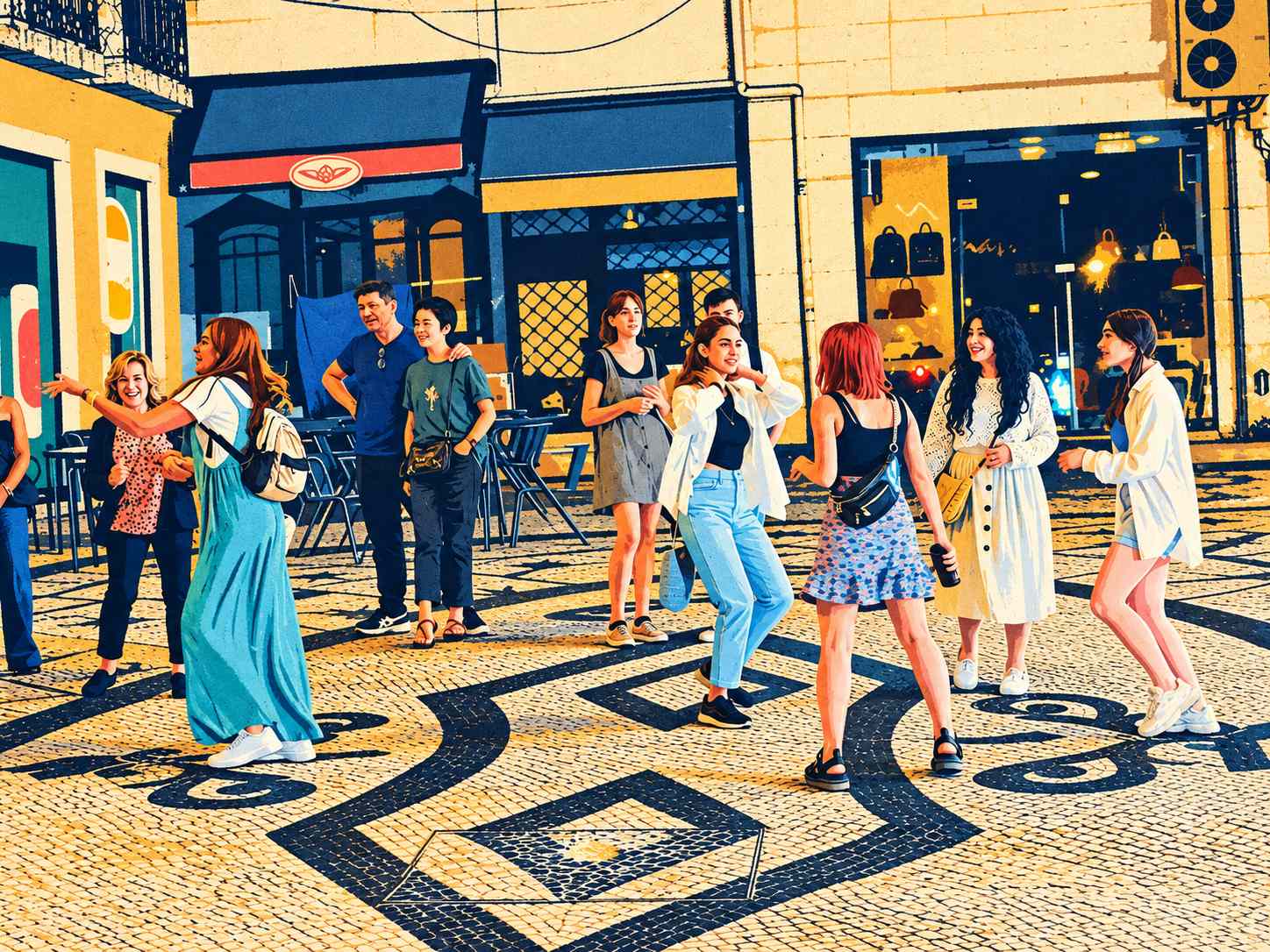
Near the middle, a dancer in pale blue trousers lifts her hands toward her shoulders. Her open cream shirt spreads into bright angular shapes around a navy top, giving her upper body a clear silhouette against the shopfront. Immediately behind her, a woman in a gray dress holds her hands together, and a partly hidden figure looks across the group. These overlapping bodies keep something of the photograph’s casual density. Posterization simplifies the clothing into large areas of color while leaving enough folds and changes of direction to explain the movement.
The red-haired dancer in the foreground supplies a different kind of anchor. Seen from behind, she wears a dark sleeveless top and a blue patterned skirt, with a black bag crossing her back. One arm drops toward a small dark object in her hand; her feet sit apart on the mosaic. To her right, a woman in a long cream cardigan smiles toward the gathering, and another dancer at the edge bends her knees beneath an oversized pale shirt. Their light clothing pulls the eye across the darker shop window. It feels conversational, even a little noisy, though the image itself has no sound.
The palette makes this complex scene readable. Navy connects the pavement pattern with window frames, clothing and deep interior shadows. Golden ochre moves through the stone façade and across the ground, making the whole street seem held together by warm light. Turquoise and powder blue separate the figures from that warmth, while coral and copper appear in smaller patches of clothing and hair. The colors repeat with enough variation to avoid a rigid pattern. A blue awning high on the left balances the blue trousers below; pale shirts answer the cream masonry above them.
Look further back and the architecture becomes a firm rectangular structure behind all those bent elbows and shifting feet. Broad awnings, a grilled doorway and the dark shop opening divide the upper half into blocks. Small hanging bags and scattered yellow highlights keep the window from becoming a blank black rectangle. Fine grain and broken edges run through the flatter color fields, suggesting the surface character of a screenprinted illustration. That texture is especially useful across the large golden areas, where a perfectly smooth fill would lose the street’s roughness.
For a living room, this is a picture that can carry a wall on its own. A narrow navy or charcoal frame would continue the darkest lines without adding another strong color around the edge. A pale mount could give the active pavement a little breathing space. Blue upholstery would find an obvious connection in the clothes and awnings, while plain wood furniture could sit comfortably beside the warmer stone tones. There is already plenty happening inside the image, so repeating its mosaic pattern in a rug immediately below it could make the whole arrangement feel crowded.
Beside Night Dances at Catania, the differences become useful: monochrome gathers a night scene around light and silhouette, while this work lets clothing, pavement and shopfronts share the attention through color. The pleasure here is in those ordinary details that survive simplification. A backpack, a loose shirt, somebody watching from behind. The poster gives them stronger edges and a common rhythm, while keeping the feeling that the gathering might rearrange itself a second later.