Dancing Beneath the Fortress
Someone has found enough space to dance, and the square seems to have arranged itself around that small decision. A couple holds an easy embrace just right of center, surrounded by other dancers, seated spectators and the broad stone presence of a fortress. Dancing Beneath the Fortress turns the supplied photograph into a poster built from golden ochre, saturated blue and one particularly useful patch of coral red. The setting has weight and history in its walls, but the people give it its pulse. There is something lovely about that mismatch of scale: enormous defenses behind an afternoon occupied with the next step.
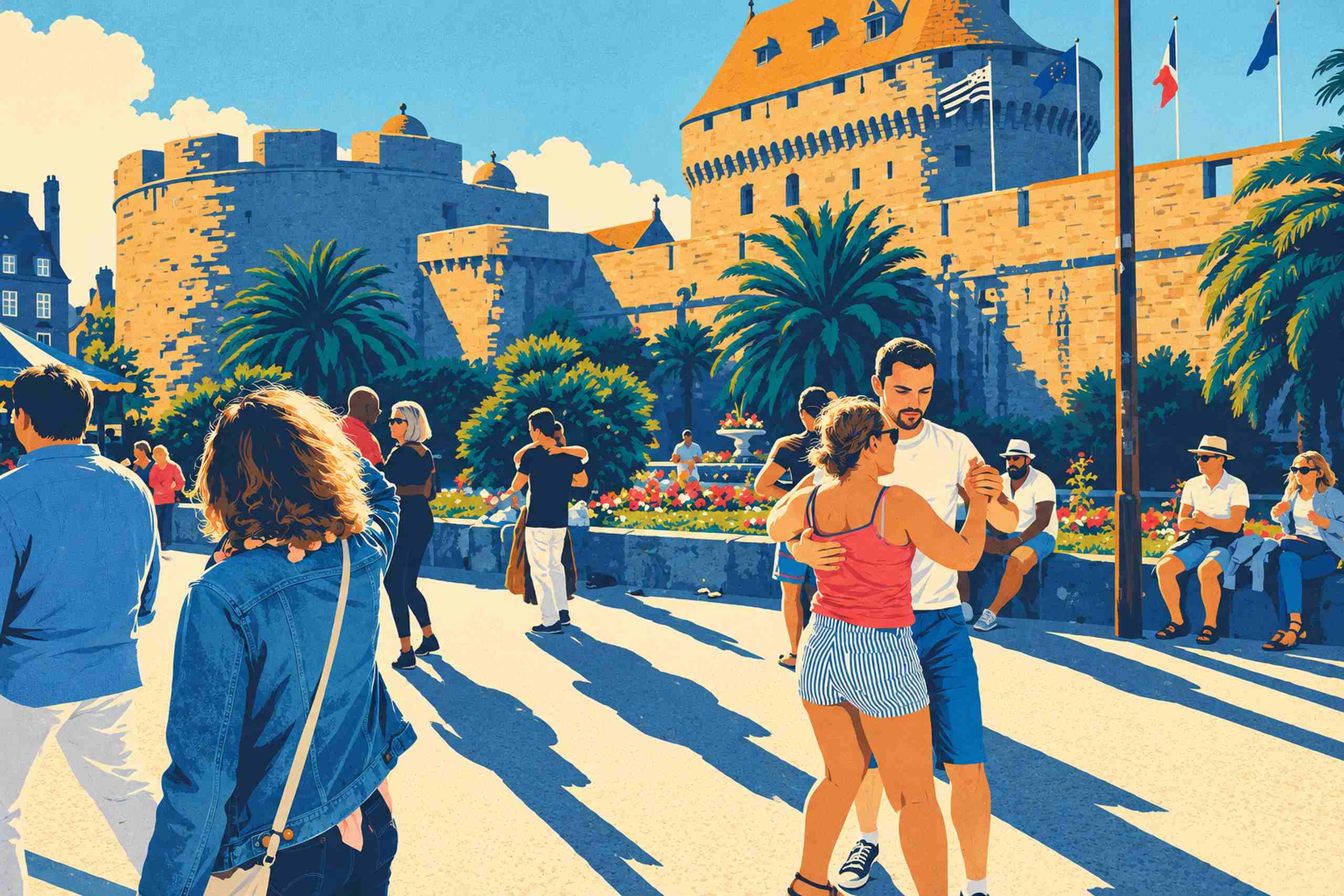
The foreground couple provides the clearest point of entry. The woman faces away from us in a coral camisole and blue-and-white striped shorts, her hair loosely gathered at the back. Her partner wears a pale shirt and blue shorts, looking down toward their shared space. Their joined hands rise to one side while his other arm rests around her back. These small connections remain readable even after the photographic detail becomes flat color. The red top gathers the eye immediately, and the stripes add a quick, lively texture against the much larger shapes of wall, paving and sky.
At the left edge, another pair is partly cut off. A blue shirt and pale trousers enter from outside the frame, while a woman seen from behind occupies a large wedge of foreground in a denim jacket. Her light shoulder strap makes a clean diagonal across the blue, and the sun catches her hair in irregular golden edges. Keeping these figures close and cropped gives the poster a sense of being inside the gathering. We are standing among the dancers, with people passing near enough to interrupt the view. A perfectly clear foreground would have made the square feel considerably less alive.
The middle distance offers a softer sequence of gestures. Another couple dances near the flower beds, a dark shirt turning against pale trousers. Small figures appear between palms and garden walls, while spectators sit along the low stone edge at the right. Their hats, folded arms and relaxed legs become economical marks rather than portraits. Bright flowers scatter red, cream and yellow across the planting strip. That narrow band is doing quite a lot of work: it separates the open plaza from the heavy building and repeats the warmth of the main dancer’s clothing without competing with it.
Above the people, the fortress forms a second, slower rhythm. A round crenellated tower rises on the left; the taller roofed structure dominates the upper right. Battlements, roof windows, masonry joints and dark openings break the architecture into overlapping planes. Ochre surfaces catch the light, while deep blue blocks describe recesses and shaded walls. Between them, the palm fronds spread into sharp, dark fans. Their curved forms soften the stone geometry and echo the outward movement of the dancers’ arms. A pale blue sky holds the upper edge open, with cream clouds preventing it from becoming an empty strip.
The long shadows are what make the whole scene hold together as a graphic print. They travel across the pale paving in broad blue diagonals, linking the dancers to the foreground and giving the open ground a strong pattern. Their scale also balances the visual weight of the fortress. Without them, the lower part of the image would be a large light area beneath a busy top half. With them, the plaza becomes another active surface. The fine grain running through the colors adds a printed character, while the larger shapes remain clear enough to read from across a room.
For a living room, I would start with the blues already in the picture. A dark steel frame could connect the shadows to a black lamp or metal side table; a natural wood frame would bring the ochre walls forward instead. Either approach leaves room for the coral top to remain the small bright surprise. There is no need to repeat that red throughout the space. One cushion or ceramic object would be enough, and even that is optional. The wide composition would sit comfortably above a low cabinet where the full gathering can be seen at once, with clear wall at either side.
Sunlit Streets 01 opens a collection around public spaces, human movement and the patterns made by strong daylight. It also offers a daylight companion to Night Dances at Catania, where illuminated architecture and monochrome contrast create a different setting for a similar shared activity. Here, color carries the afternoon: warm stone against cool shadows, dark palms against open sky, and a coral-clad dancer quietly holding the center of attention. The fortress supplies the grand backdrop. The people make the picture worth staying with.