Night Dances at Catania
There is a whole evening happening around the fountain, and nobody seems particularly interested in posing for it. Couples dance in the foreground, people sit along the monument’s base, a small child stands beside a stroller, and others linger at the edges of the square. Night Dances at Catania takes that wonderfully untidy social scene from the supplied photograph and gives it the force of a black-and-white poster. The architecture supplies the grand setting, but the people give the picture its pulse. I like that balance: a famous-looking monument can hold the middle of an image without claiming all the attention.
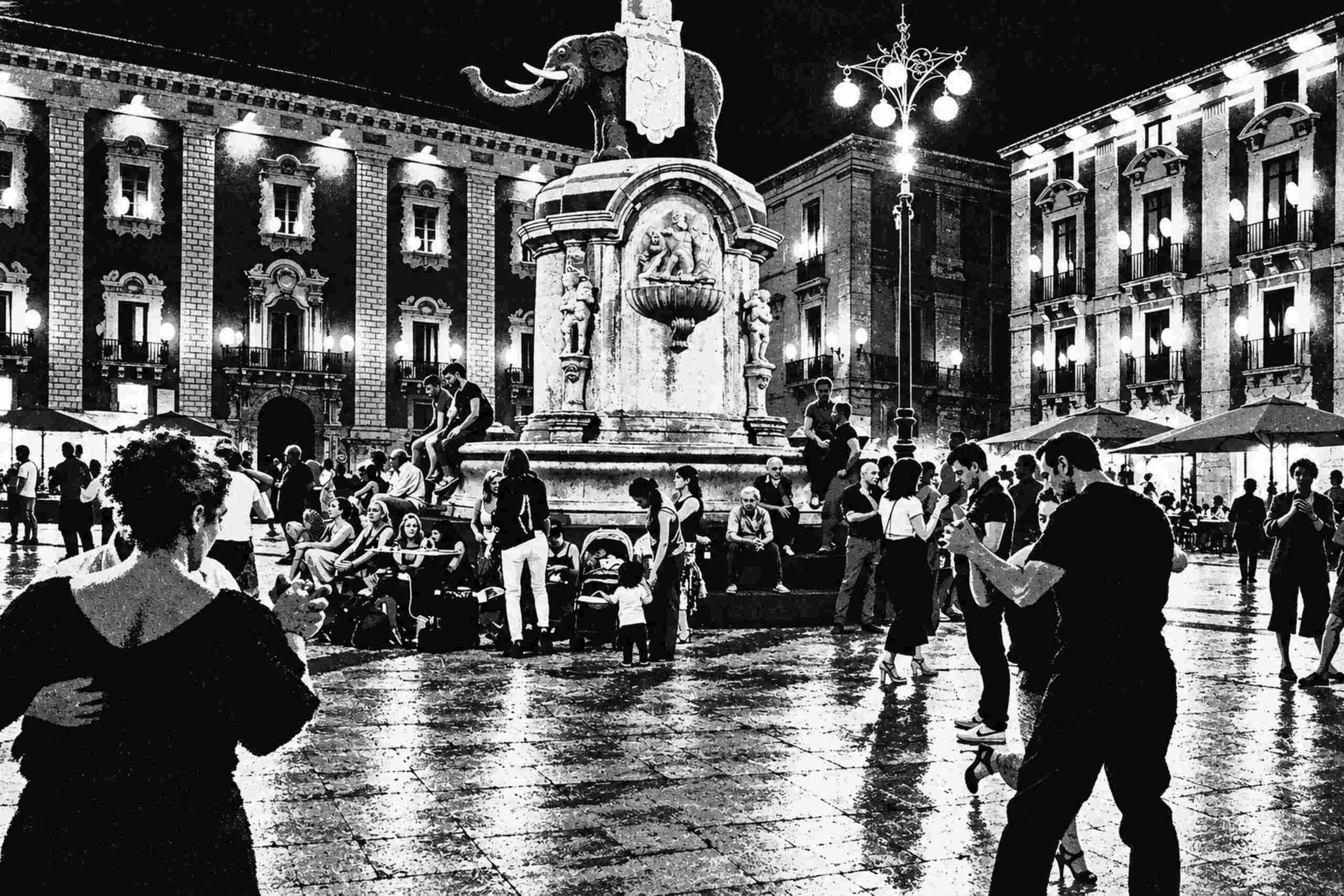
At the center, the elephant stands above a pale, heavily modeled fountain, its raised trunk cutting a distinctive curve into the dark sky. Below it, curved moldings, sculpted figures and the rounded basin catch the light in broken white patches. The fountain has enough detail to remain a substantial piece of architecture, yet its broad pale mass also works as a simple visual anchor. Everything seems to gather around it. People perch on the ledges at either side, while the seated group below forms a loose horizontal band across the composition. Their arrangement feels incidental, which is precisely what gives the scene its warmth.
The foreground is much less orderly. On the left, a woman seen largely from behind becomes a broad dark shape, interrupted by the pale curve of her neckline and the joined hands of her dance partner. The couple is partly cropped, bringing the viewer close enough to feel almost in the way. Across the open paving, another pair occupies the right foreground, with a dark shirt, bent arms and a lifted heel making the dance legible without any explanation. Farther back, a woman in a light top and dark trousers turns the human movement into a smaller echo. These separate gestures let the eye travel through the picture rather than stopping at a single central subject.
Above the dancers, the facades introduce a slower rhythm. Repeated windows, narrow balconies and elaborate stone surrounds run along both sides of the square. The lamps punctuate that repetition with bright circles and ovals, culminating in the branching streetlight just right of the fountain. Its white globes stand out against an almost solid black sky. Down at ground level, cafe umbrellas make a low sequence of overlapping triangles. Between them and the dancing figures, the pavement opens into a pale, scratched-looking field, crossed by dark joints and broken shadows. There is plenty to examine, but the main shapes remain clear from a distance.
The monochrome treatment is doing more than removing the original color. Deep clothing shadows become strong silhouettes, illuminated stone becomes a connected pale structure, and the little pools of light begin to rhyme across the frame. Grain gives the surface a printmaking-like roughness. This is an AI-assisted reinterpretation, with details simplified or reworked; it should be read as artwork derived from the photograph. The distracting advertisement behind the fountain has also given way to quieter architectural shadow. That change lets the dancers, lamps and monument share one visual language. No lettering has been added, so the title belongs to the article rather than competing with the scene.
On a wall, I would give this poster enough space for the foreground figures to hold their full width. A slim black frame would connect naturally with the silhouettes, while a modest white mount could create a pause between the busy square and the surrounding room. Pale plaster, gray paint, brushed metal or warm timber could all support it. The useful question is how much other pattern sits nearby. Beside a crowded bookcase, the smaller faces and windows might become one texture among many; above a relatively clear sideboard, those same details have room to emerge. A bright lamp reflected in the glazing would compete directly with the printed streetlights, so placement deserves a quick check from the seat opposite.
The landscape composition is essential to its sociability. It leaves room for more than one couple, for spectators who are watching and people who are occupied with something else entirely. Unlike the invented harbor in Night Windows at Dusk, this work starts with a photographed gathering and keeps its informal human density. The hosted JPG is an editorial preview; a physical edition would need separate file preparation and proofing. What makes the image worth carrying onto a wall, though, is already there: the elephant remains perfectly still while the square below it refuses to settle down.