Sea Lions in the Sun
The sea lions have claimed almost every useful patch of sunshine, and they appear entirely satisfied with the arrangement. Across a series of floating wooden platforms, their bodies form a busy scatter of dark backs, lifted necks and warm ochre flanks. Sea Lions in the Sun takes the supplied waterfront photograph and turns that pleasantly chaotic gathering into a graphic landscape, with turquoise water running between golden docks and navy shadows holding the whole composition together. There is plenty happening here. What makes it work as a poster is that all that activity settles into a few strong colors before the smaller stories begin to emerge.
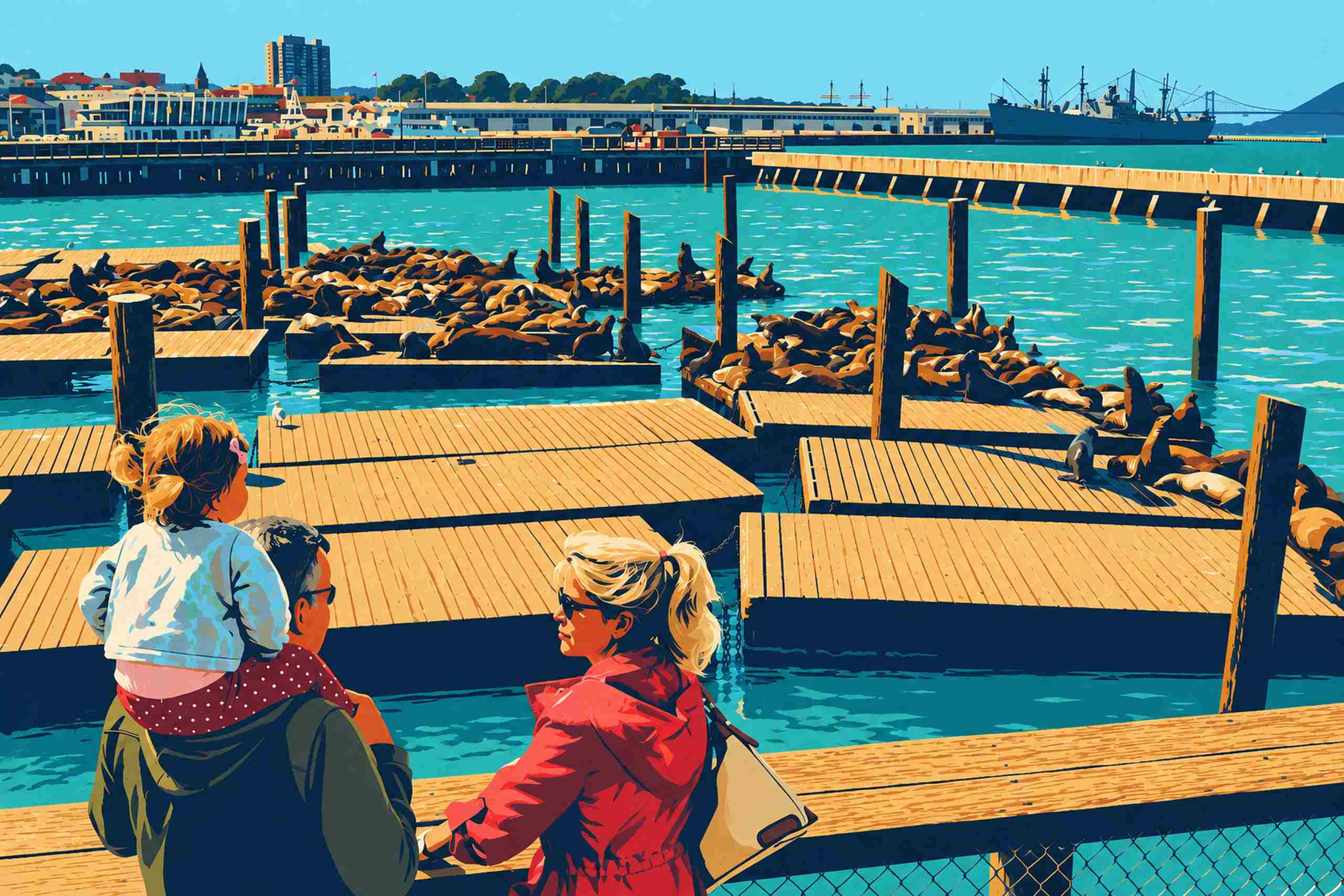
The foreground gives the picture its human scale. At the lower left, a small child sits on an adult’s shoulders, her pale patterned top standing out against the dark clothing beneath her. Her turned head directs attention toward the animals, so we enter the scene as another spectator leaning over the railing. Beside them, a woman in a coral-red jacket looks back across the foreground. Her light hair, dark sunglasses and pale shoulder bag break into crisp patches of color. That jacket is the strongest red in the image, and its position matters: it keeps the eye close to the people before the open water carries it toward the distant shore. Cropping the figures at the bottom preserves the feeling of a passing moment.
Beyond the visitors, the docks become an arrangement of broad, overlapping planes. Long plank lines stretch across their warm yellow surfaces, then disappear into deep blue edges and the narrow channels between platforms. Upright timber posts interrupt those horizontals at irregular intervals. Some lean slightly; others stand like dark exclamation marks above the animals. The large empty platform near the middle is particularly useful. Surrounded by crowded resting places, it provides a quiet patch of sunlight where the eye can pause. Filling it with more sea lions would make the scene busier and the poster less convincing.
The animals remain wonderfully untidy. A few sit upright with pointed muzzles raised, while others lie sideways, overlap their neighbors or seem to vanish into a single dark heap. Golden highlights separate shoulders and backs from the navy mass below. There is enough variation to suggest individual postures without requiring a detailed drawing of every whisker. This is where the posterization earns its place. The photograph’s many close shades of brown become a clearer rhythm of warm light and cool shadow, and the colony reads across the width of the image.
Farther out, turquoise water opens a generous breathing space. Small pale strokes suggest ripples without rebuilding every reflection. A long waterfront pier cuts across the upper third, backed by low buildings, a taller block and a broken line of trees. To the right, a large ship sits as a dark silhouette, its masts and rigging drawn against the clear sky; the distant bridge adds another fine structural line. Those details give the harbor depth, but their restrained colors keep them behind the sunlit docks. The sky is almost the simplest part of the picture, which is exactly what this crowded waterfront needs.
As a wall piece, I would treat the warm timber color as the main connection to the room. An oak sideboard, a honey-colored shelf or even one wicker chair could pick it up without turning the space into a seaside theme. A narrow navy or natural wood frame would suit the image, with enough clear wall around it to let the long horizontal composition register. The coral jacket could answer a single small red object elsewhere in the room; repeating every color would feel rather labored. In a living room with strong daylight, check glazing reflections from the usual seat, because a bright reflected window can swallow the smaller sea lion shapes.
Tidal Studies 03 extends the collection from isolated marine forms into a populated waterfront scene. The artwork was created through an AI-assisted reinterpretation of the supplied photograph, with details simplified and reworked into a screenprint-like surface. Its appeal comes from the meeting of two kinds of leisure: visitors stop to watch, while the sea lions carry on doing very little at all. The golden platforms, cool water and one bright jacket make that ordinary afternoon feel worth keeping.