Munich Iconic
Some cities are recognizable from their skylines, others from the particular way their buildings meet the street. Munich manages both in this view toward Marienplatz. The Old Town Hall rises on the right, its pale facade topped by a steep red-tiled roof and slender corner turrets. Farther away, almost squeezed into the gap between the buildings, stand the familiar green onion domes of the Frauenkirche. It is an unusually satisfying combination of two architectural landmarks in a single street-level composition, with the crowds and shopfronts of contemporary Munich providing the connection between them.
The clock tower has an almost theatrical presence. Its blue and gold dial stands out against the light-colored masonry, while the repeated dark window frames and painted geometric ornament establish a quieter rhythm down the facade. At street level, the pointed arch is a wonderfully practical interruption to all this vertical grandeur: people pass through it, and the city continues on the other side. The architecture is not presented as a solitary monument in an empty square. It is part of the everyday movement of Munich, which is precisely what makes the image appealing as a city poster.
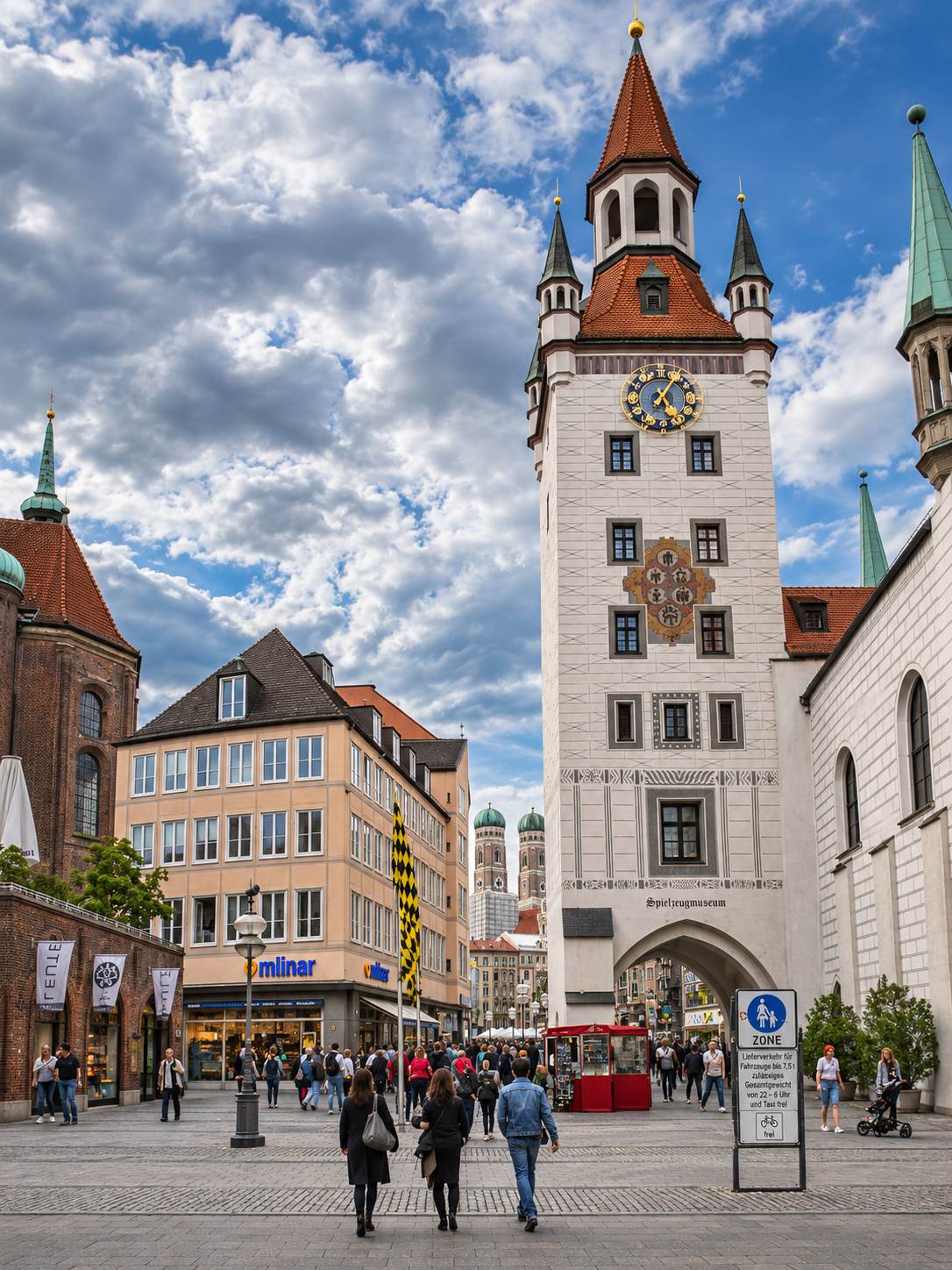
The sky deserves nearly as much attention as the buildings. Great banks of white and gray clouds move across a rich blue background, introducing irregular, almost painterly shapes into a composition otherwise governed by straight lines and steep roof pitches. On the left, the warm peach facade of a corner building and the darker brickwork provide a counterweight to the tower. A yellow-and-black flag and a small red kiosk contribute flashes of saturated color lower in the frame. The combination feels distinctly Bavarian without relying on a caption, a costume or a collection of tourist symbols.
Three pedestrians walking away from the viewer give the foreground a sense of scale and direction. Their dark clothing and blue denim echo the darker rooflines and the sky, while the pattern of the pavement guides the eye toward the busy square. The human figures occupy relatively little of the image, yet the composition would lose something essential without them. It is the contrast between monumental architecture and ordinary street life that keeps this view from becoming a conventional architectural elevation.
As a vertical photographic poster, Munich Iconic is particularly well suited to a hallway, a narrow stretch of wall beside a bookcase or the space between two tall windows. The strong upward movement of the clock tower makes the portrait format feel entirely natural. A warm white mount and a slender dark walnut or black frame would give the detailed street scene a clean boundary. For a room with more color, a muted blue wall could echo the sky and the clock face, provided there is enough contrast between the wall and the frame. A rust-colored textile or a small brass accessory might bring out the terracotta roof and golden clock without making the room feel like a themed interior.
There is also a case for keeping this work separate from a dense gallery wall. The architecture, clouds and street activity already provide plenty of visual information. As an illustrative arrangement, a 30 by 40 cm portrait image with a modest mount can occupy a narrow wall comfortably, rather than competing with several similarly detailed city photographs. The image is especially interesting alongside the broader horizontal composition of Stockholm Waterfront Reflections, another approach to a recognizable European city within the Sunlit Streets collection. Munich’s identity here is not distilled into a logo or a skyline silhouette. It emerges from the layers of the street itself, from the pedestrians at ground level all the way up to the golden finial against the clouds.