Summer Among the Ruins
A ruined arch catches the sun, and three people find a place above it to stop for a while. Summer Among the Ruins takes this small, unhurried encounter and gives it the concentrated color of a landscape poster: limestone turns honey yellow, the wooded slope settles into overlapping blue-green shapes, and the darkest foliage becomes a nearly solid bank of ink. There is no destination name stamped across the scene. Its appeal comes from the view itself, from the meeting of broken masonry, summer vegetation and people who seem perfectly happy to spend part of their afternoon there.
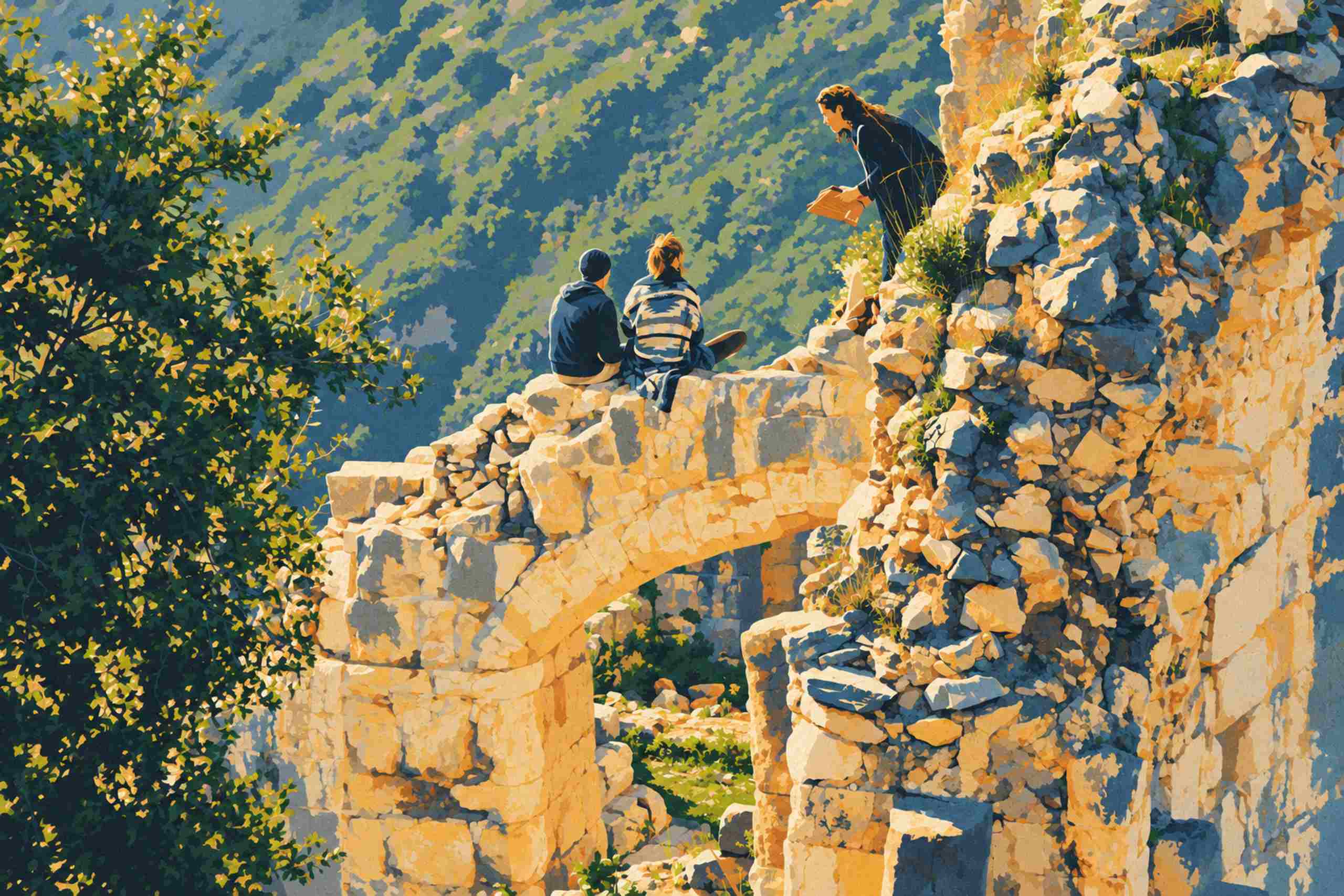
The arch is the image’s great organizing gesture. It rises from the lower left and curves across the center, its pale underside enclosing a smaller view of grass, scattered stones and another patch of shadow. Individual blocks remain visible, but their surfaces have become broad planes of cream, gold and muted gray. The curve provides an immediate route through the picture. Your eye follows it toward the seated pair, then moves across to the standing figure and the taller wall at the right. What might otherwise be a crowded arrangement of rubble becomes a clear sequence of shapes.
That right-hand wall deserves a closer look. It fills almost the entire height of the composition, with a rough outer edge that steps outward and inward as fragments of stone interrupt the silhouette. Sunlit faces glow ochre; deeper joints collect navy and slate blue. Small tufts of grass emerge from the broken courses, softening the abrupt meeting of masonry and open air. The poster treatment makes the wall feel almost assembled from pieces of colored paper, though the irregular stones retain enough character to suggest their weight. It is a substantial foreground presence, something close enough to touch.
On the opposite side, a leafy tree creates a darker, looser frame. Its branches and clusters of leaves spill inward from the left edge, punctuated by yellow-green highlights where sunlight catches them. Instead of describing every leaf separately, the image groups them into patches that alternate between dense shadow and bright flecks. This keeps the tree from competing with the arch’s outline. It also gives the gold stone a strong neighbor: the masonry looks warmer because the foliage beside it is so deep and cool. A few small branches reaching toward the center keep that dark area lively.
The hillside behind the ruins works quite differently. It is spacious and comparatively gentle, built from diagonal bands of sage, olive and dusty blue. There is no hard horizon or strip of sky; the slope continues beyond the top of the image, wrapping the figures in vegetation and distance. The reduction in detail helps separate this background from the sharply broken stone nearby. It also makes the location feel enclosed, as though the ruins sit within a much larger fold of land. The setting is recognizable as a wooded landscape without needing a geographic claim that the photograph alone cannot establish.
Then there are the visitors, small enough to belong to the scene but distinct enough to make it personal. Two sit together above the arch, their backs toward the viewer. One wears a dark blue hooded top and close-fitting cap; the other has tied-back hair and a loose garment patterned with broad pale and blue bands. Their shoulders form a compact pair of vertical shapes against the slope. Higher at the right, a third figure leans forward beside the wall, dressed in dark clothing and holding a warm orange rectangular object. The three positions create an easy triangle. Their pause gives the architecture a human scale, and a little everyday life, too.
Posterization strengthens those relationships by asking each color to do several jobs. Navy describes clothing, foliage shadows and the recesses between stones. Cream links the brightest masonry with the striped garment. Ochre moves from the arch to the wall and into small highlights around the figures. Fine surface grain stops the larger fields from feeling mechanically smooth. The result has the visual character of a printed illustration while keeping the original photograph’s particular arrangement, including its slightly unexpected viewpoint across the broken arch.
For a wall placement, the wide format offers a useful balance of movement and stillness. A simple charcoal frame would pick up the deepest shadows, while warm wood would echo the golden stone. A cream wall could let the blue-green hillside read clearly; a muted green wall would bring the warmer masonry forward. The picture already carries plenty of texture, so a nearby cabinet or desk with a plain surface would give it room. There is no need to surround it with imitation archaeological objects. The small figures, the curve of the arch and that broad hillside supply enough of a story on their own.