Stockholm Waterfront Reflections as a Photographic City Poster
Stockholm’s old town takes on a different character when seen from the water. Streets, shopfronts and all the smaller distractions disappear, leaving a long ribbon of warm buildings under an enormous blue sky. The historic waterfront of Gamla Stan stands in full sunlight, yet the water below is almost navy black. Between those two fields of blue, the pale boats and the gold, brick red and cream facades form a remarkably clear composition. This photograph already has the balance of a city poster. It does not need a slogan across the sky to explain where we are.
The most striking decision in the framing is the space given to the foreground. The skyline occupies a relatively narrow band across the middle of the image, while calm water stretches far below it. A more conventional sightseeing photograph might crop away most of that dark expanse to bring the buildings closer. Here it gives the scene its quiet character. The horizontal line of the quay becomes a visual hinge, separating the detailed city above from a second, softer version of it in the reflections. It is an architectural scene with room to breathe.
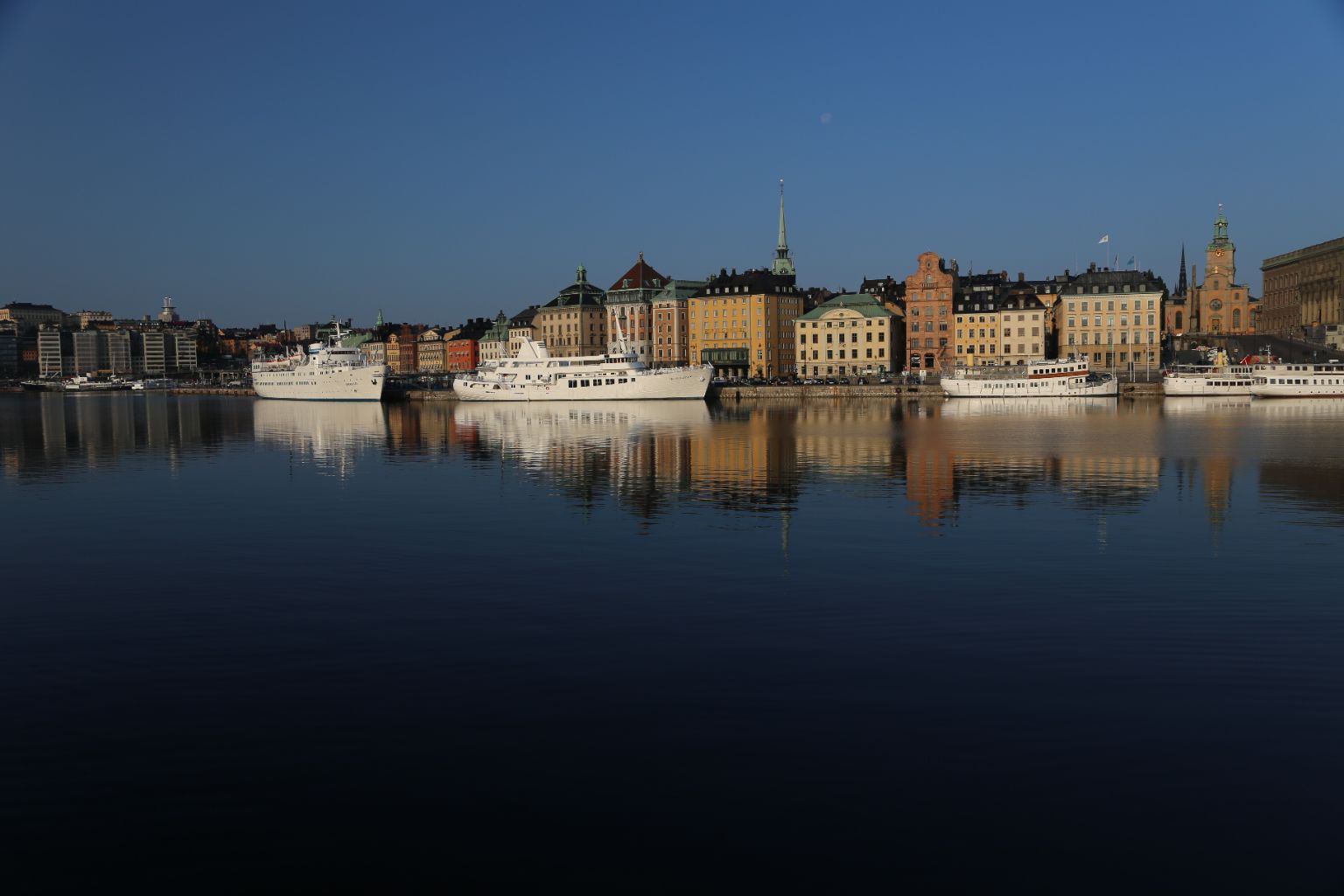
There is plenty to look at along the shoreline without the image becoming restless. On the left, a large white passenger vessel sits broadside to the viewer, its upper decks and railings making a crisp silhouette against the buildings behind. Closer to the center, another long white boat has a low, almost streamlined profile. Farther right, smaller white vessels repeat that same brightness at intervals along the quay. Their shapes keep the waterfront recognizably maritime, but they do something useful for the design as well: the boats interrupt the darker edge of the shore with long pale accents, giving the eye several places to rest.
Behind the boats, the architecture changes color, height and style every few steps. Pale yellow and peach walls alternate with reddish brick and warm ochre, while rows of windows form fine dark grids. One narrow green church spire rises near the center, a taller clock tower marks the right side, and a large stone building enters at the extreme edge. The roofline is irregular without feeling chaotic. Triangular roofs, small domes and stepped facades stand above the mostly rectangular waterfront houses. Even at a distance, the differences in their proportions prevent the historic town from flattening into a decorative strip.
The light pulls these varied facades together. Sun reaches the fronts of the buildings and the white hulls, creating a continuous band of brightness against the cooler sky. There is no dramatic orange sunset here, and that restraint is part of the appeal. The sky stays blue, the towers hold their greenish copper tones, and the buildings keep the slight variations of their real materials. It is an unusually satisfying palette for a photographic poster: navy, muted cobalt, cream, warm brick and a little green. Color is present without having to shout.
Look below the quay and the tidy geometry starts to come apart. Window grids and rooflines dissolve into long vertical streaks, some gold, some deep blue, some faintly reddish. The reflections are strongest just beneath the boats and buildings, then thin out toward the lower part of the frame. At the very bottom, the water approaches black. That gradient is worth keeping intact. It gives the lighter skyline a stable base and leaves a substantial area of negative space, a feature that would be lost if the photograph were cropped too tightly or brightened indiscriminately.
As a wall piece, the landscape format would suit a long, low sideboard or a work area where there is generous horizontal room. A narrow black or dark bronze frame could echo the shadowed water without adding another competing color. A pale wooden frame would make the image less formal and pick up the sunlit facades. A wide white mount is an option for a bright wall, although it should be judged against the photograph’s dark outer edges. The image does not require a large arrangement of neighboring posters. Its quiet lower half and busy upper skyline provide their own contrast.
Placement matters more than matching every color in the room. A lamp directly opposite the glazed surface could throw a bright reflection across the line of boats, where the photograph carries much of its fine detail. In a room with side lighting, the darker water can remain rich while the architecture stays legible. If the picture is displayed above a desk, keeping it slightly apart from a cluttered shelf will help the uninterrupted stretch of blue do its job. This is a city view that benefits from some empty wall around it.
Within Posterial’s Sunlit Streets collection, the photograph brings a calmer sort of urban energy. The movement belongs mostly to the water, even though the boats and buildings suggest a working capital beyond the frame. It also makes a useful companion to Night in Auray, France, another waterfront composition whose reflections carry as much visual weight as the houses above them. Stockholm’s version is cooler and more spacious. The modest surprise is how little the foreground seems to contain, and how essential that dark blue stillness becomes when the picture is seen as a whole.